

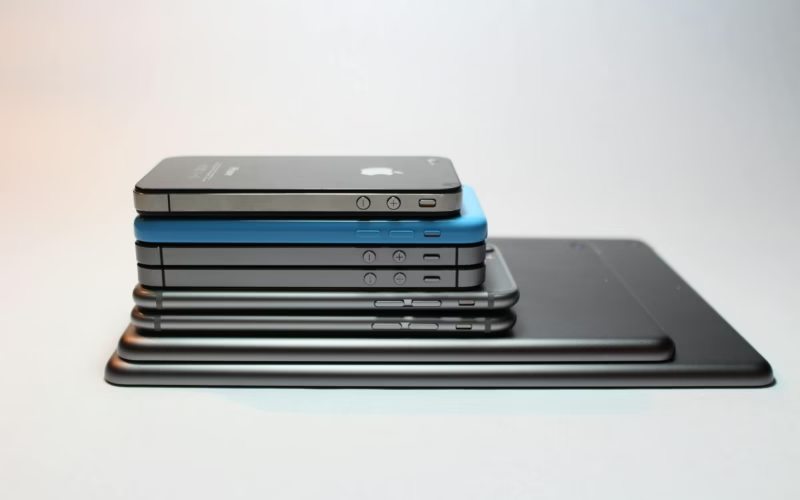
Smartphone Evolution is arguably the single most rapid and pervasive technological transformation in human history, changing not just how we communicate, but fundamentally reshaping societal structures, economics, and personal behavior. In the span of just two decades, these sleek, handheld devices morphed from bulky bricks primarily used for voice calls into sophisticated pocket supercomputers, capable of navigating the globe, editing 4K video, instantly accessing the totality of human knowledge, and serving as our primary connection to the digital sphere. The journey from the rudimentary PDA (Personal Digital Assistant) to today’s indispensable artificial intelligence companion represents a stunning, continuous leap in hardware miniaturization, software ingenuity, and user expectation.
The Foundation: From Clunky Communicator to Pocket Computer
To appreciate the modern device, one must look back at the tentative, often awkward, steps that preceded it. The idea of a phone that could perform additional operations dates back to the early 1990s. The IBM Simon Personal Communicator, released in 1994, is often cited as the world’s first true smartphone. While massive by modern standards and expensive, it combined a mobile phone with features like a calendar, address book, world clock, and the stunning novelty of a touch screen and the ability to send email and faxes. It was a conceptual breakthrough, but lacked the necessary processing power and network infrastructure to truly thrive.
The late 1990s and early 2000s were dominated by devices like the PalmPilot, BlackBerry, and Nokia Communicator series. These devices focused on productivity, emphasizing email, calendar synchronization, and physical keypads. BlackBerry, in particular, became the professional standard, offering secure, instantaneous text communication (BBM) that redefined mobile business interaction. However, these devices were defined by their segmentation—they were good at communication or good at organizing data, but clumsy when trying to merge the two. They operated on proprietary software and required significant user commitment to master their complex button layouts and stylus input systems. The phone was a separate tool from the music player, which was separate from the camera—a situation rapidly approaching its breaking point in the marketplace.
The Dawn of the Modern Interface: A Stunning Shift
The true revolutionary moment arrived in 2007. The introduction of the iPhone fundamentally altered user expectations, shifting the focus from hardware buttons and stylus input to the capacitive multi-touch interface. This single change—making the screen the sole interface and prioritizing accessibility through fluid gestures—unlocked the smartphone’s potential for mass market adoption. The device was no longer just a communication tool; it was a portal to the nascent mobile internet.
This pivot was immediately followed by the emergence of Google’s Android operating system, which adopted a similar touchscreen-centric model and introduced widespread competition. The rivalry between Apple’s tightly controlled ecosystem and Google’s open-source flexibility fueled an intense technological arms race that benefited consumers immensely. The concept of the “App Store” soon followed, providing a dedicated digital distribution platform for third-party software. This move was the final element required to turn the pocket phone into a universal utility tool, enabling users to customize their device for everything from banking and navigation to social media and entertainment.
The Core Engine Driving Smartphone Evolution: Processing Power
The incredible functionality we take for granted today is underpinned by vast and consistent improvements in internal hardware, particularly in the realm of the System-on-a-Chip (SoC). These tiny chips integrate the CPU (Central Processing Unit), GPU (Graphics Processing Unit), and various controllers, allowing complex operations to be handled locally on the device with minimal power drain.
Early smartphones ran at single-digit megahertz speeds and struggled with simple tasks like loading web pages. Modern flagship SoCs contain billions of transistors, utilizing multiple cores clocked in the gigahertz range. They are more powerful than the desktop computers of a decade ago. This immense power has enabled entirely new categories of features:
1. Augmented Reality (AR): Processing complex layers of digital information overlaid on the real world in real-time.
2. Machine Learning (ML) Acceleration: Dedicated Neural Processing Units (NPUs) handle AI tasks, speeding up everything from voice recognition (Siri, Google Assistant) to computational photography.
3. Advanced Gaming: Running console-quality 3D games smoothly.
The relentless pace of this specific aspect of Smartphone Evolution ensures that the devices continue to shrink slightly while multiplying their computational capabilities exponentially, setting the stage for future integration with virtual reality headsets and always-on AI assistants.
The Essential Lenses: The Transformation of Mobile Photography
Few areas illustrate the “stunning evolution” better than the smartphone camera. Initially, mobile cameras were novelties—low-resolution VGA sensors that produced grainy, poorly lit images. Dedicated digital compact cameras ruled the photography market. The smartphone killed the compact camera industry not by imitating quality, but by offering superior convenience and, eventually, computational mastery.
The modern mobile camera is not purely dependent on high-end optics or giant sensors; it is a blend of hardware and sophisticated software. Thanks to high-speed processors, when a user presses the shutter button, the phone is often already capturing dozens of frames simultaneously. AI algorithms then analyze these frames, correcting for light, enhancing detail, removing digital noise, and even adding complex effects like the visually shallow depth of field (bokeh) that traditionally required expensive DSLR lenses. This concept is computational photography, making it possible for anyone to take professional-looking photos instantly and share them globally within seconds.
The integration of advanced camera features (multiple lenses—wide, ultrawide, telephoto—and night modes) cemented the smartphone’s role as the primary recording device of human experience. This shift didn’t just democratize photography; it changed archiving and memory-making itself.
Beyond Calls and Text: The Toolkit of Modern Life
The designation of the smartphone as “essential” stems from its role as an ultimate convergence device, consolidating previously separate tools into a single unit. It has become the primary key to accessing and interacting with modern infrastructure:
Navigation and Travel
Before smartphones, reliance on paper maps or standalone, single-function GPS units was standard. Today, real-time mapping services offer dynamic travel analysis, taking into account traffic, construction, and public transit schedules. Geo-location services also power ride-sharing platforms, proving that the phone is not just a guide, but often the facilitator of the journey itself.
Finance and Commerce
The shift from cash and physical cards to mobile wallets (Apple Pay, Google Wallet) utilizing Near Field Communication (NFC) chips has made transactional commerce completely mobile. Furthermore, smartphones serve as platforms for banking applications, stock trading, and peer-to-peer payment systems, placing users in immediate control of their financial lives, often secured through highly accurate biometric scanners like fingerprint readers and face recognition.
Health and Wellness
Modern devices are increasingly used as personal health managers. They track steps, measure heart rate, monitor sleep cycles, and can integrate with wearables to detect irregularities. In cases like smartwatches connected to a phone, they are capable of performing an ECG (electrocardiogram), effectively turning a consumer gadget into a lightweight medical diagnostic assistant. This health utility further underscores its essential nature, intertwining technology with physical well-being.
The Future Trajectories and the Unending Evolution
Despite its current dominance, the smartphone is not a finalized product; its evolution is ongoing. Current trends suggest its interface will become even more integrated into our immediate environment.
One major area of continued development is the emergence of foldable and flexible screens. These devices are aimed at bridging the gap between the portability of a phone and the screen real estate necessary for tablet-level productivity, offering users dynamic control over their form factor.
Furthermore, artificial intelligence is poised to become less of an application and more of an underlying operating system function. Future smartphones will likely be defined by their proactive AI capabilities, predicting user needs, summarizing complex data before it is formally requested, and managing communication streams with ever greater autonomy. The goal is to move beyond simply answering questions based on keywords toward performing complex, multi-step tasks using natural language inputs.
Another major focus is extending connectivity through 5G and future 6G networks, enabling true machine-to-machine communication necessary for autonomous vehicles and expansive smart city infrastructure. The smartphone will act as the essential personal node in this vast, interconnected network.
Conclusion
The stunning transformation of the mobile phone from a simple telephony device to a multimedia, computational powerhouse reflects not only genius engineering but also an incredible responsiveness to human need. Today’s slim, glass rectangle is the primary tool for education, employment, creativity, and connection. While the rapid pace of change brings challenges—concerns over digital privacy, screen time, and planned obsolescence—the fact remains that the smartphone is now inextricably woven into the fabric of modern existence. It is a testament to technological ingenuity that a device so compact can hold so much power and utility, affirming its status not just as a stunning invention, but as an absolutely essential component of 21st-century life.
