

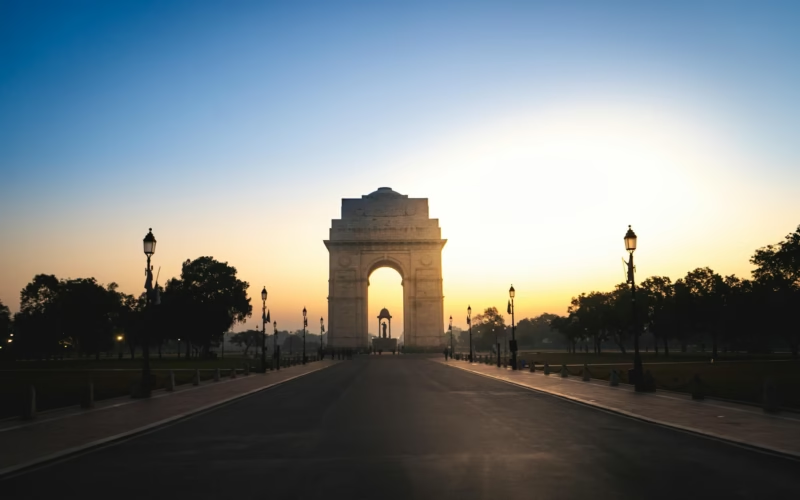
The Unfiltered Lens: A Deep Dive into Delhi’s Essential Independent Cinema
Independent Films Delhi represent a vital, often gritty, counter-narrative to the polished mainstream machinery of Indian cinema. While Mumbai traditionally dominates the industry’s commercial output, the National Capital Region (NCR) has quietly become the epicenter for stories that demand authenticity, sacrificing spectacle for visceral reality. This movement is not just about alternative distribution; it is about Delhi itself—a city of stark political contrasts, ancient history layered over ruthless modernity, and stories simmering just below the surface of glossy headlines. These cinematic entries, often overlooked by multiplex crowds, are essential viewing for anyone seeking an honest, multifaceted portrait of contemporary India.
The unique flavor of Delhi’s independent filmmaking stems directly from its environment. Unlike the often escapist glamour associated with Bollywood, Delhi-based narratives frequently dive into the complexities of class friction, political disenfranchisement, rapid urbanization, and the psychological weight of societal expectations. The capital is a hotbed of tension—a melting pot where power and poverty exist in extreme proximity—and this proximity provides an explosive canvas for ambitious, self-funded filmmakers.
The Unique Canvas: Why Delhi Stories Resonate Differently
Filmmakers in Delhi leverage the city’s inherent dramatic architecture. The stories are often set against the backdrop of the tightly packed lanes of Old Delhi, the sprawling, anonymous housing colonies, or the stark, imposing government infrastructure of Lutyens’ Zone. This geographical mosaic allows independent directors to explore themes specific to the region that seldom find mainstream funding:
1. Political Satire and Tension: As the seat of governance, Delhi naturally fuels political commentary. Independent films here often utilize dark humor, sharp dialogue, or subtle allegory to critique bureaucratic inertia, social unrest, and ideological conflicts that permeate university campuses and public spaces.
2. Linguistic Authenticity: The language of Delhi is a potent cultural identifier. Independently made films often reject standardized Hindi for the raw, hybrid dialect—a mix of Haryanvi, Punjabi, and colloquial Hinglish—that captures the energy and brusqueness of the capital’s inhabitants.
3. The Psychology of Space: Delhi is large and isolating. Its independent films frequently focus on urban solitude, the search for identity amid relentless growth, and the silent struggles of migration, often using the city’s concrete jungles or its vast Metro system as visual metaphors for emotional distance.
4. Focusing on the Periphery: Many of the most compelling works shift their perspective entirely, focusing on the lives in the satellite cities (Gurugram, Noida, Faridabad) where the promise of modernization collides violently with traditional values and infrastructure challenges.
These elements combine to create a cinema that sometimes feels difficult or uncomfortable, but always feels profoundly true—a stark contrast to the escapism traditionally offered by the larger industry.
Navigating the Indie Ecosystem and the Distribution Challenge
The journey for an independent filmmaker in Delhi is fraught with financial and logistical hurdles. Securing funding often means relying on micro-grants, crowd-funding, or personal familial investments, leading to tighter production schedules and highly resourceful filmmaking. The Delhi film circuit, however, is supported by a dedicated network of film schools, universities (like Jamia Millia Islamia or Ambedkar University), and local cultural bodies that foster collaboration and critical dialogue.
Crucially, the rise of regional Indian film festivals—both within the NCR and nationally—has provided the necessary initial platform. Festivals serve not just as screening venues but as vital networking hubs where filmmakers can connect with international distributors, streaming platforms, and critics. The success of a film originating from Delhi often depends entirely on its critical reception at these festivals, as traditional theatrical release remains prohibitively expensive and typically prioritizes mainstream content.
The primary transformative agent for these films has been the digital revolution. Platforms specializing in world cinema and independent narratives have provided a crucial bypass around the traditional distribution bottleneck. This shift has allowed small-budget, high-concept films to find global niche audiences who actively seek out challenging and geographically specific storytelling.
The Must-Watch Canon: Essential Independent Films Delhi Has Produced
To understand the core strengths of this regional filmmaking, one must look closely at the thematic diversity and the courageous storytelling displayed in the finished products. The true gems of this movement defy easy categorization but often fall into distinct narrative clusters, reflecting the city’s complex soul.
Showcasing Independent Films Delhi: Themes of Urban Discomfort and Class Friction
The most powerful Delhi independent films often tackle the brutal realities of wealth disparity and the psychological cost of ambition in a ruthless meritocracy. These films demonstrate a mastery of location, using the geography of the NCR to visually depict social stratification.
1. Narratives of Entitlement and Aspiration:
These films frequently explore the generational divides within Delhi families—the struggle of the youth to reconcile modern aspirations with conservative expectations, often leading to moments of profound moral ambiguity. These stories avoid clear heroes and villains, focusing instead on systemically flawed characters trapped between the glamour of the new city and the entrenched traditions of their communities. The visual grammar often opts for claustrophobic framing and a muted color palette to emphasize the emotional density of the environment.
2. Focus on the Unseen Labor Force:
Another essential category rigorously documents the lives of those who make the capital run—the street vendors, domestic workers, security guards, and auto-rickshaw drivers. These are highly empathetic films, often shot with a docu-fiction style, blurring the lines between staged performance and real hardship. By focusing the lens on these marginalized communities, the filmmakers offer a necessary counterpoint to the narratives centered on privilege. These films serve as powerful sociological documents, forcing viewers to confront the invisible infrastructure of the capital.
Political Commentary and Satire Under the Cloud of Power
Given Delhi’s role as the political nerve center, many of its most vital independent productions center on themes of activism, dissent, and the pervasive surveillance inherent in powerful democracies. These are films that demand courage, both from the director and the audience.
1. Campus Life and Intellectual Dissent:
The university space is a frequent setting for socio-political dramas. These entries often track the ideological battles fought on campus grounds, exploring the tension between freedom of expression and state control. They are characterized by sharp, intellectual dialogue and often utilize a non-linear narrative structure to mimic the confusion and intensity of political mobilization. These projects are critical because they capture the immediate, high-stakes atmosphere of socio-political change occurring in real-time within the NCR.
2. Bureaucratic Absurdity and Dark Comedy:
A uniquely Delhi subgenre is the political dark comedy. These powerful films use absurdism and biting satire to lampoon the slow, often corrupt, bureaucratic processes that define daily life in the capital. They often feature ensemble casts of minor government functionaries, perpetually overwhelmed by paperwork and the illogical dictates of higher authorities. The humor is derived from painful recognition, offering a cathartic way to process the often-frustrating reality of navigating Indian governance.
The New Wave: Experimental and Identity-Driven Independent Films Delhi is Promoting
Beyond the social realist and political dramas, the current wave of independent Delhi filmmaking is pushing aesthetic boundaries, often dealing with personal identity, gender, and sexuality in ways that mainstream cinema is hesitant to approach.
1. Queer Narratives and Urban Isolation:
These films are invaluable for their contribution to expanding the representation landscape. Shot with intimate precision, they often focus on the search for safe spaces and understanding within a city that is simultaneously liberalizing and conservatively resistant. The use of atmospheric sound design and striking visual compositions captures the emotional isolation and eventual resilience required to navigate non-traditional identities in a metropolitan environment.
2. Genre Bending and Cinematic Hybridity:
A growing trend involves filmmakers blending established genres with local flavor—for instance, taking the tropes of a neo-noir thriller but grounding the plot entirely in the gritty markets and congested flyovers of Ghaziabad or Dwarka. By infusing global cinematic structures with distinctly local socio-economic anxieties, these emerging directors are finding fresh, exciting ways to tell familiar yet unique stories. This hybridity showcases the sophistication and cinematic literacy of the new generation of Delhi filmmakers.
The Road Ahead for Delhi’s Indie Filmmaking
The continued vitality of Independent Films Delhi hinges on sustainability and visibility. While digital platforms have revolutionized access, the financial strain of production remains immense. Future growth will rely on further development of regional incubation funds, stronger connections with international production partners, and continued support from major film festivals seeking unconventional voices.
Ultimately, the power of independent cinema emanating from the capital lies in its refusal to look away. These films are demanding, enlightening, and essential, serving as raw, unfiltered artifacts of contemporary life in one of the world’s most dynamic and confusing cities. For viewers seeking films that prioritize truth over tested formulas, the Delhi independent circuit offers a stunningly rich catalog worthy of immediate exploration.
