

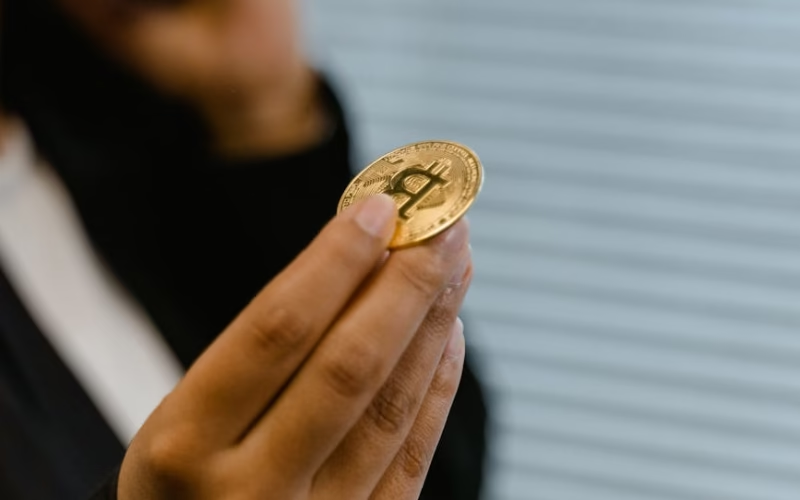
Blockchain Uses are rapidly accelerating beyond their initial association with cryptocurrencies, cementing the technology’s role as a foundational layer for trust and transparency across nearly every sector of the global economy. Originating as the distributed ledger technology underpinning Bitcoin, blockchain has evolved into a versatile tool capable of solving complex problems related to data integrity, ownership verification, and intermediary elimination. Its key innovation lies in creating a permanent, immutable record of transactions or data exchanges that is shared among many participants, making it virtually impossible to tamper with. This shift from centralized databases to decentralized registries offers massive potential to reduce fraud, lower operating costs, and fundamentally redefine how businesses and individuals interact digitally. From verifying pharmaceutical origins to securing digital identities for billions, the ten applications detailed below represent the stunning and essential ways this technology is already transforming our world.
The Foundation of Trust: Exploring Essential Blockchain Uses
The true power of blockchain lies not only in its ability to record transactions but to enforce accountability and transparency where traditional systems often fail. These applications harness the power of decentralization to create more resilient, efficient, and equitable systems.
1. Decentralized Finance (DeFi)
Decentralized finance (DeFi) is arguably the most recognized sector utilizing blockchain technology today, offering traditional financial services—like lending, borrowing, and trading—without relying on traditional banks, brokers, or centralized exchanges. Built primarily on programmable blockchains such as Ethereum, DeFi leverages smart contracts to automatically execute actions when predefined conditions are met.
This removes the need for human intermediaries, speeding up transactions and dramatically lowering fees, particularly for global transfers. DeFi provides access to financial tools for the world’s unbanked population and creates highly transparent, permissionless markets. Users maintain full control over their assets via private wallet keys, eliminating counterparty risk associated with centralized custodians.
2. Revolutionizing Supply Chains
The journey a product takes from raw material extraction to the consumer’s hands is often opaque, making it difficult to verify origin, purity, or ethical sourcing. Blockchain solves this by providing an immutable, shared ledger for all participants in a supply chain, including suppliers, manufacturers, distributors, and logistics firms.
Every step—from processing to shipping to quality control certification—can be recorded as a block. This provides consumers with verifiable proof of authenticity (crucial for luxury goods, fine art, and pharmaceuticals) and allows companies to quickly pinpoint the source of contamination or inefficiency, thereby dramatically limiting the scope and cost of product recalls. This enhanced traceability reduces fraud and improves consumer confidence.
3. Secure Digital Identity
In the digital age, managing identity is risky, inefficient, and often requires sacrificing personal privacy to centralized organizations. Blockchain enables the concept of Self-Sovereign Identity (SSI), where individuals own and control their own digital identifiers and data.
Instead of storing credentials (like passports, driver’s licenses, or educational degrees) on centralized servers prone to security breaches, SSI stores verified proofs of identity on a blockchain. Users can then selectively share necessary credentials using cryptography, revealing only the specific information required (e.g., proving they are over 18 without revealing their date of birth). This reduces identity theft and gives individuals greater autonomy over their personal information.
4. Healthcare Record Management
Healthcare systems often struggle with fragmented or siloed patient data, making it difficult for providers to access comprehensive histories quickly and securely, especially when treating patients across various institutions. Furthermore, the sensitive nature of medical records requires robust protection against unauthorized access.
Blockchain’s decentralized structure and cryptographic security offer a solution, creating a permanent, encrypted record of a patient’s medical history that can be accessed only by authorized parties using private keys. Not only does this streamline administrative processes and improve diagnostic accuracy, but it also allows researchers to access anonymized, aggregated data securely for medical advancements, without compromising patient privacy.
5. Enhancing Democratic Processes
Trust in electoral integrity is paramount to democracy, yet traditional paper and machine voting systems are often vulnerable to manipulation, error, or logistical bottlenecks. Blockchain introduces the possibility of highly secure and transparent digital voting.
By recording each vote as an encrypted transaction on a decentralized ledger, the system ensures that every person can vote only once and that their vote cannot be altered after submission. The transparency of the ledger allows the public to verify that all votes have been counted accurately, while the cryptographic security protects the anonymity of the voter. Although challenges remain regarding scalability and accessibility, blockchain promises a future of auditable and tamper-proof elections.
6. Streamlining Real Estate Transactions
Buying and selling property is notorious for being document-heavy, slow, costly due to various legal and financial intermediaries, and susceptible to title fraud. In many parts of the world, accurate land registries are non-existent or easily corrupted.
By utilizing smart contracts and tokenized real estate, blockchain can drastically simplify the home buying process. Land titles can be digitized and secured on an immutable public ledger, ensuring undisputed, transparent ownership records. Tokenization allows fractional ownership of high-value properties, making investment accessible to a broader audience, while smart contracts automate the transfer of funds and deeds once agreed-upon conditions (like inspections and funding) are met.
7. Protecting Intellectual Property (IP) and Copyright
The instant sharing nature of the internet makes protecting creative works, patents, and copyrighted material increasingly difficult for artists, inventors, and content creators. Proving ownership and tracking usage can be an administrative nightmare.
Blockchain provides a simple and indisputable mechanism for timestamped proof of existence and ownership. When an artist registers a piece of digital art, a song, or a patent idea on the blockchain, that timestamped record serves as definitive proof that the content existed in their possession at a specific moment. Furthermore, Non-Fungible Tokens (NFTs) can embed royalties directly into the asset’s code, ensuring that creators automatically receive a set percentage every time their work is resold on a secondary market, fundamentally changing IP monetization.
8. The Future of Ownership in Gaming (Web3)
The gaming industry is undergoing a massive shift fueled by blockchain, transitioning from traditional models where players rent in-game assets to a Web3 model where players genuinely own them.
This application utilizes NFTs to represent unique in-game items—such as skins, weapons, or virtual land—allowing players to trade, sell, or even transfer these assets outside of the game’s original ecosystem. This concept of play-to-earn empowers users financially and creates genuine digital economies. Beyond simple asset ownership, blockchain ensures full transparency in game mechanics and item scarcity, fostering greater trust between developers and players.
9. Decentralized Energy Trading
Blockchain is improving the efficiency and sustainability of global energy grids, particularly those implementing decentralized renewable energy sources like household solar panels. Smart grids often face challenges balancing supply and demand across diverse producers.
Blockchain allows individuals and businesses with surplus power (e.g., solar homes) to automatically and securely sell that excess energy directly to neighbors or other participants in the microgrid, without using a centralized utility company as a broker. Smart contracts manage the exchange, recording transactions instantly and accurately. This peer-to-peer approach encourages the uptake of renewable energy and increases grid resilience.
10. Automated Insurance and Claims
The insurance industry is often burdened by slow, manual claims verification processes that are expensive and prone to error or fraudulent claims. Blockchain dramatically simplifies the claims process through the use of smart contracts and verifiable external data sources (oracles).
For example, travel insurance covering flight delays can be written into a smart contract. If an external oracle provides verifiable data confirming that a specific flight was delayed by the contracted duration, the smart contract automatically executes and disburses payment to the policyholder instantaneously, without the need for manual review, phone calls, or paperwork. This leads to massive reductions in processing costs and significantly improved customer satisfaction.
Beyond Speculation: The Inevitability of Widespread Blockchain Uses
These ten examples represent only the starting point of realizing the full potential of this technology. Blockchain’s strength lies in its modularity—its ability to be tailored to specific industry needs, whether through public chains, permissioned private chains, or hybrid models. As large corporations, governments, and startups continue to invest heavily in development and interoperability, the underlying benefits of transparency, immutability, and decentralization will continue to drive global innovation.
While technical hurdles such as scalability, regulatory clarity, and user experience still require navigation, the long-term trajectory is clear. The shift away from centralized data control toward systems built on mutual, cryptographic trust is redefining digital interactions. The successful implementation of these stunning applications promises a future that is more secure, more equitable, and dramatically more efficient across almost every facet of modern life.
