

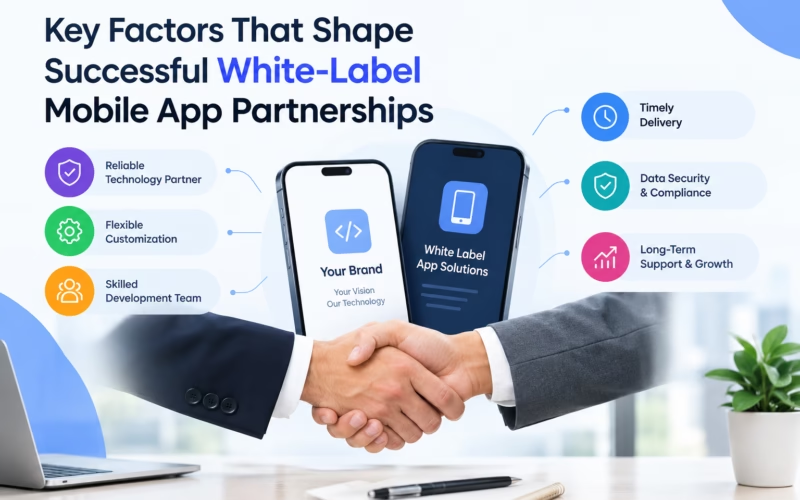
In a competitive digital marketplace, businesses are constantly looking for ways to launch mobile applications without spending years developing technology from scratch. White-label mobile app partnerships have emerged as a practical solution, allowing companies to offer branded digital experiences while relying on an experienced technology provider for the underlying software, infrastructure, and maintenance.
However, launching an app under your own brand is only one part of the equation. The real challenge lies in building a partnership that supports business growth, adapts to changing customer expectations, and delivers consistent value over time. Choosing the right White Label App Development Services can help businesses achieve these goals by providing the technical expertise, customization options, and ongoing support needed to create a reliable branded application. A visually appealing app may attract initial interest, but its long-term success depends on technical reliability, strategic alignment, effective communication, flexibility, and a shared understanding of business goals.
A successful white-label partnership should therefore be viewed as more than a software purchasing arrangement. It is a collaborative relationship in which both parties contribute to creating a sustainable digital product.
From selecting the right development partner to establishing clear ownership rights, several factors determine whether this collaboration becomes a competitive advantage or an ongoing operational challenge. Understanding these factors helps businesses make informed decisions before committing their resources.
1. Choosing a Partner That Understands Your Business Vision
The foundation of a successful white-label mobile app partnership is choosing a provider that understands what your business is trying to accomplish.
Different companies have different objectives. A retail brand may want to improve customer retention, a fitness business may focus on subscription renewals, and a logistics company may need to streamline delivery operations. Although each organization might use a white-label application, their requirements, workflows, and measures of success will differ considerably.
A provider that concentrates exclusively on delivering standard software may overlook these distinctions. In contrast, a strategic partner takes time to understand the target audience, competitive environment, revenue model, and long-term business plans.
Before signing an agreement, discuss the problems the application should solve and the outcomes it should support. Ask prospective partners how their platform can accommodate your business model, rather than simply asking which features are included.
It is also useful to evaluate whether the provider has experience serving businesses with comparable operational needs. Relevant experience can help identify potential implementation challenges before they become expensive problems.
The right partner does not simply supply an application; it helps translate your business objectives into a workable digital solution.
2. Product Customization and Brand Consistency
White-label software typically offers a ready-made foundation that businesses can adapt to their own identity. Nevertheless, the level of customization available can vary significantly between providers.
Brand consistency involves much more than placing a company logo on the login screen. Customers should experience a coherent identity through the application’s colors, typography, navigation, content, notifications, and overall interaction design.
A food delivery business, for example, may want a streamlined ordering process with prominent product imagery. A financial services company might prioritize clarity, secure authentication, and easy access to account information. Using an identical interface for both businesses could weaken the experience each brand wants to create.
Before selecting a platform, establish which elements can be customized and which remain fixed. Important considerations include:
- Logo placement, color schemes, typography, and other visual elements.
- Navigation structure and customer journeys.
- Feature configuration and business-specific workflows.
- Notifications, communication templates, and content management.
- Integration with existing websites, customer relationship management systems, and payment services.
It is equally important to understand the cost and complexity of future changes. Some providers allow extensive configuration through administrative dashboards, while others require paid development work for relatively small adjustments.
The ideal arrangement balances the speed of a ready-made platform with enough flexibility to create a recognizable and useful branded experience.
3. Technical Reliability and Application Performance
Customers rarely think about the technology operating behind a mobile application when everything works properly. They notice it immediately when pages load slowly, transactions fail, or the application repeatedly crashes.
Technical reliability is therefore a central factor in evaluating a white-label partnership. A provider may offer an impressive feature list, but those features have limited value if the software cannot perform consistently under real-world conditions.
Businesses should assess application responsiveness, server reliability, compatibility with supported devices, and the provider’s approach to performance testing. They should also understand how the platform handles growing user numbers and periods of unusually high demand.
Scalability deserves particular attention. An application that serves a few hundred customers may operate smoothly during its early stages but encounter difficulties when the customer base expands substantially. The underlying infrastructure should be capable of supporting anticipated growth without requiring a complete rebuild.
Ask potential partners about uptime commitments, incident response procedures, backup practices, monitoring tools, and disaster recovery arrangements. Request evidence of performance testing where appropriate, rather than relying entirely on sales presentations.
The agreement should also identify responsibility for technical incidents. Businesses need to know who investigates failures, who communicates with affected customers, and how quickly critical problems are expected to receive attention.
A dependable technical foundation allows companies to concentrate on customer acquisition and business development instead of repeatedly resolving preventable software issues.
4. Transparent Pricing and a Sustainable Commercial Model
Cost is often one of the main reasons businesses consider white-label mobile applications. Compared with commissioning a completely bespoke platform, a ready-made solution may reduce initial development expenses and shorten the route to market.
However, the initial quotation rarely tells the whole financial story.
A partnership can become expensive if essential services are excluded from the advertised price or if every change requires an additional payment. Businesses should therefore examine the complete cost structure before making a commitment.
Potential expenses include setup and branding, subscription fees, transaction charges, third-party integrations, premium features, technical support, maintenance, and future customization. Depending on the commercial arrangement, there may also be costs associated with publishing updates, migrating data, or terminating the contract.
A useful approach is to estimate the total cost of ownership over at least the first two or three years. This makes it easier to compare providers offering different pricing structures.
Revenue arrangements also require careful consideration. Some providers charge a fixed recurring fee, while others use transaction-based pricing, revenue sharing, or a combination of models. Each approach has different implications as usage increases.
A transparent partner explains what is included, what triggers additional charges, and how future price adjustments will be handled.
The objective should not be to find the cheapest provider at any cost. It should be to establish a commercially sustainable relationship in which the price reflects the platform’s reliability, capabilities, and contribution to business growth.
5. Data Security, Privacy, and Regulatory Responsibilities
A mobile application may handle customer identities, contact details, payment information, location data, purchase histories, or other sensitive information. Protecting that information is essential for customer trust and business continuity.
White-label arrangements can create additional complexity because the brand owner and technology provider may share responsibilities for storing, processing, securing, and managing data.
These responsibilities should be clearly documented before the application launches.
Businesses should investigate the provider’s authentication controls, encryption practices, access management, vulnerability management, security testing, and incident response procedures. They should also determine whether the platform relies on third-party vendors and how those vendors are evaluated.
Regulatory requirements depend on the business’s location, customer base, industry, and data-processing activities. For example, a company serving customers in different jurisdictions may need to consider applicable privacy laws, financial regulations, or industry-specific obligations.
Neither party should assume that the other automatically handles every compliance requirement. The agreement should identify who is responsible for privacy notices, consent management, data-subject requests, retention policies, and regulatory reporting where applicable.
Businesses should also establish what happens if the partnership ends. Customer information should not become inaccessible simply because a commercial relationship has changed. Data export, deletion, retention, and transfer procedures need to be defined in advance.
Strong security practices protect more than information. They preserve reputation, reduce operational exposure, and demonstrate that customer trust is treated as a business priority.Writing
6. Clear Communication and Defined Responsibilities
Even a technically strong partnership can struggle when communication is inconsistent or responsibilities are poorly defined.
In a white-label arrangement, the brand owner and technology provider may work across different departments, time zones, and organizational structures. Without a clear communication process, minor misunderstandings can lead to missed deadlines, duplicated work, and frustrated customers.
Both parties should agree on how decisions will be made, how progress will be reported, and who has authority over different aspects of the project.
For instance, the brand owner might manage customer research, marketing, and business requirements, while the technology provider handles platform configuration, software maintenance, and technical troubleshooting. Certain activities, such as release approval and customer incident communication, may require joint coordination.
A practical communication framework should include:
- A designated relationship manager from each organization.
- Regular project reviews with documented decisions and action items.
- A shared system for tracking bugs, feature requests, and delivery milestones.
- Clear escalation procedures for urgent technical or commercial issues.
- Agreed response times for routine questions and critical incidents.
Communication should also continue after the initial launch. Product performance, customer feedback, and upcoming business priorities need regular discussion.
When both parties know what they are responsible for and how to raise concerns, the partnership becomes easier to manage. More importantly, problems can be addressed before they affect customer confidence or commercial performance.
7. Integration Capabilities and Compatibility With Existing Systems
A mobile application rarely operates in isolation. Most businesses already use systems for customer management, accounting, inventory, payments, marketing automation, or order processing.
A white-label app should fit into this existing environment instead of creating another disconnected source of information.
Integration capabilities can influence everything from operational efficiency to the quality of the customer experience. If an application cannot communicate with the systems a business depends on, employees may need to enter information manually, increasing the likelihood of errors and delays.
Before selecting a provider, identify the systems the application must connect with and determine whether suitable integrations already exist. If a custom connection is required, clarify its development cost, maintenance responsibilities, and expected delivery timeline.
Application programming interfaces (APIs) can provide flexibility by allowing different systems to exchange information. However, the availability of an API does not automatically guarantee a smooth integration. Documentation quality, authentication methods, rate limits, data formats, and version compatibility all matter.
It is also worth examining how integrations will be maintained when external services change. A payment provider updating its API or a business replacing its CRM should not create an unexpected crisis.
A well-integrated white-label application becomes part of the company’s broader digital ecosystem. This creates a more consistent experience for customers while helping internal teams work with accurate, connected information.
8. Ongoing Support, Maintenance, and Product Updates
Launching an application marks the beginning of its operational life, not the end of the project.
Mobile operating systems evolve, device requirements change, security vulnerabilities emerge, and customer expectations continue to develop. An application that receives no meaningful maintenance can gradually become unreliable or difficult to use.
For this reason, businesses should examine the provider’s long-term maintenance strategy before entering a partnership.
Ask how frequently updates are released, how urgent security patches are handled, and whether updates are tested before reaching production. It is equally important to understand whether customers receive advance notice of significant changes.
A shared white-label platform introduces an additional consideration: an update intended to improve the product for one customer group should not unintentionally disrupt another group’s configured features.
The provider should have a structured release process that includes testing, documentation, monitoring, and rollback procedures where appropriate.
Support arrangements should specify operating hours, issue severity levels, response targets, and escalation responsibilities. A critical payment failure, for example, requires a different response from a minor visual defect.
Businesses should also ask whether support includes training, configuration assistance, and guidance on new features or whether these services carry additional charges.
Reliable post-launch support protects the value of the original investment. It also allows the business to maintain a consistent customer experience as the technology and market evolve.
9. Intellectual Property, Contracts, and Exit Planning
A white-label mobile app partnership creates a relationship between two businesses with different assets and responsibilities. Those boundaries must be established clearly.
The technology provider may own the underlying platform, source code, and reusable components, while the brand owner controls its name, visual identity, marketing materials, and customer relationships. Custom development may introduce additional questions about ownership and licensing.
A written agreement should explain what each party owns, what each party is permitted to use, and what restrictions apply during and after the partnership.
It should also address customer data, confidentiality, liability, service-level commitments, renewal terms, and the conditions under which either party can terminate the arrangement.
One frequently overlooked issue is what happens when the relationship ends.
A business should not discover after several years that it cannot export customer records, retrieve important configuration details, or migrate to another provider without significant disruption. The agreement should establish practical procedures for data export, transition assistance, deletion of retained information where appropriate, and continued service during an agreed transition period.
Exclusivity also deserves careful thought. A provider may offer a particular business exclusive access to a market or industry segment, but such restrictions should have a clear commercial purpose, defined boundaries, and appropriate legal review.
Planning for an orderly exit does not demonstrate a lack of trust. It demonstrates sound business management.
A partnership is stronger when both parties understand their rights and obligations and neither depends on uncertainty to preserve the relationship.
10. Customer Feedback and Continuous Improvement
A successful white-label partnership should be guided by evidence rather than assumptions.
Business owners may believe customers want more features, but usage data and direct feedback could reveal that the real problem is a confusing checkout process or an unnecessarily complicated registration flow.
Establishing a feedback loop helps both parties identify these opportunities.
Useful sources include customer surveys, app reviews, support tickets, usage analytics, conversion rates, and customer retention data. These signals should be reviewed together because a single metric rarely explains the complete picture.
For example, an increase in downloads may appear positive, but it does not necessarily indicate that users are completing purchases or returning to the application. Similarly, a feature that receives frequent requests may not deliver enough value to justify its implementation cost.
The brand owner should bring customer and market insights to regular product reviews. The technology provider should explain what is technically feasible, identify dependencies, and recommend practical improvements.
Both parties can then prioritize changes according to customer impact, commercial value, implementation effort, and risk.
It is also important to distinguish between genuine product improvements and requests that benefit only a small number of users. Not every suggestion needs to become a new feature.
Continuous improvement works best when decisions are transparent, measurable, and connected to the broader business strategy.
11. A Shared Roadmap for Long-Term Growth
The strongest white-label mobile app partnerships are designed to evolve alongside the businesses they serve.
A company may begin with a basic application that supports bookings, purchases, or customer communication. As its customer base grows, it may need loyalty programs, advanced analytics, additional payment methods, new languages, or more sophisticated automation.
If the original platform cannot accommodate these developments, the business may eventually outgrow the solution it initially selected.
To reduce this risk, both parties should discuss their expectations for the next one to three years. This does not require predicting every future requirement. Instead, it means identifying likely growth scenarios and understanding the platform’s capacity to support them.
A shared roadmap should distinguish between essential maintenance, planned enhancements, and optional innovations. It should also explain how feature requests are evaluated, how development costs are allocated, and how competing priorities are resolved.
The provider should communicate relevant changes to its platform, including planned improvements and limitations that could affect the brand owner’s strategy.
Meanwhile, the brand owner should share meaningful business developments that could influence technical requirements, such as entering a new market or introducing a different revenue model.
This forward-looking approach helps prevent short-term decisions from creating long-term limitations.
Conclusion
Successful white-label mobile app development depend on much more than choosing an attractive application template or negotiating a competitive price. They require a combination of strategic alignment, brand flexibility, dependable technology, transparent commercial terms, robust security, effective communication, and ongoing collaboration.
Businesses should evaluate prospective providers as long-term technology partners rather than temporary suppliers. That means asking difficult questions early, documenting responsibilities, assessing the complete cost of ownership, and establishing clear expectations for support and future development.
It also means recognizing that both parties contribute to the outcome. The technology provider brings software expertise and operational capabilities, while the brand owner contributes market knowledge, customer relationships, and a clear understanding of business objectives.
When these strengths work together, a white-label mobile application can become more than a convenient route to market. It can support stronger customer relationships, improve operational efficiency, and create new opportunities for sustainable growth.
Ultimately, the most successful partnership is one that remains valuable after launch day. By prioritizing trust, accountability, adaptability, and shared goals from the beginning, businesses can build a digital foundation that serves their customers today while remaining ready for tomorrow’s opportunities
