

A Balanced, Evidence-Based Look at Whether Implants Are Right for You
It is a question that comes up in dental consultations across Sydney every single day. A patient has lost a tooth, or is facing the loss of one, and they want to know what their best option is. They have done some searching online. They have seen the word “implants” mentioned consistently. And now they are sitting across from a dental professional wondering whether the answer really is that straightforward, or whether there is something they are missing.
The honest answer is that dental implants are, for the majority of suitable adult patients, the most clinically sound and longest-lasting tooth replacement solution currently available. That conclusion is supported by decades of research, endorsed by the Australian Dental Association, and reflected in the daily clinical experience of dental professionals treating tooth loss across the country.
But “best” is a word that deserves some unpacking. Best in terms of longevity? Best in terms of aesthetics? Best for every patient regardless of their individual health circumstances? Understanding what dental implants genuinely offer, and where other options may play a role, is the kind of informed perspective that allows patients to make decisions they feel truly confident about.
This article explores that question honestly, drawing on current clinical understanding to help Sydney patients think clearly about their tooth replacement options.
The Problem Implants Are Designed to Solve
To assess whether implants are the best option, it helps to start with a clear picture of the problem they are designed to address.
Tooth loss is not simply a cosmetic issue. When a tooth is removed or falls out, the bone that once surrounded and supported its root begins to deteriorate. Without the mechanical stimulation that a tooth root provides during chewing and everyday function, the body gradually reabsorbs that bone tissue. This process, known as bone resorption, can begin within months of tooth loss and continues progressively over time.
The consequences extend well beyond the visible gap. Neighbouring teeth can drift toward the space, disrupting the alignment of the bite. The opposing tooth, with nothing to bite against, can super-erupt out of its normal position. Over years, significant bone loss can alter the structure of the jaw and change the shape of the face in ways that add years to a person’s appearance.
From a clinical standpoint, addressing tooth loss promptly and with a solution that preserves bone is among the most impactful things a patient can do for their long-term oral health. That is the foundation of the case for dental implants, and it is grounded in biology rather than aesthetics.
What Makes Implants Clinically Distinct
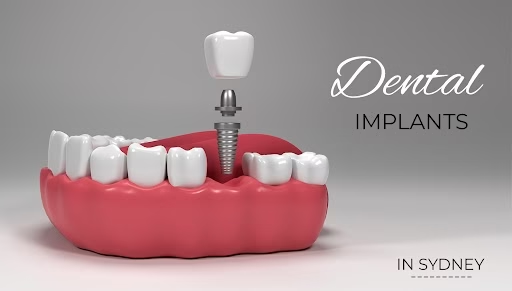
Dental implants are the only tooth replacement option that replicates the function of a natural tooth root. A small titanium post is placed into the jawbone and, over a period of weeks to months, integrates with the surrounding bone through a process called osseointegration. This creates a stable, bone-anchored foundation for a custom-made restoration, whether that is a single crown, a bridge, or a full arch of teeth.
Because the implant is embedded in the bone, it stimulates the jaw during function in the same way a natural tooth root does. This stimulation actively prevents bone resorption in the area, preserving the volume and density of the jaw over time.
No other tooth replacement solution does this. Removable dentures rest on the gum surface and can, over time, accelerate the bone loss beneath them. Conventional dental bridges are supported by adjacent natural teeth, which must be permanently reshaped to accommodate the bridgework, and they do not address the underlying bone at the site of the missing tooth.
For most patients with adequate bone volume and good general health, implants offer a level of stability, longevity, and biological compatibility that other options simply cannot match. The Australian Dental Association recognises implants as a clinically proven solution with a well-documented track record, and success rates in appropriately selected patients consistently exceed 95 percent.
How Do Implants Compare to the Alternatives?
A genuinely useful answer to whether implants are the best option requires an honest comparison with the alternatives. Every patient deserves to understand the full picture, not just the most persuasive version of a single option.
Dental Bridges
A fixed bridge can be an appropriate solution in certain clinical situations, particularly when the adjacent teeth have already been restored with crowns and would benefit from further work regardless. The procedure is generally completed more quickly than implant treatment and does not involve surgery.
The significant drawback is the requirement to permanently alter healthy adjacent teeth. Even a perfectly healthy tooth must be ground down substantially to serve as a bridge anchor, which compromises its long-term structural integrity and increases its susceptibility to decay and nerve damage over time. Additionally, the bridge does not address the underlying bone loss at the site of the missing tooth.
For patients with otherwise healthy dentition, sacrificing sound teeth to support a bridge represents a clinical trade-off that many experienced practitioners consider suboptimal when implant treatment is a viable alternative.
Removable Partial Dentures
Partial dentures can replace one or several missing teeth using a removable appliance that clips onto existing teeth or rests on the gum tissue. They are generally the least expensive initial option and require no surgery.
In practice, however, removable partial dentures come with considerable functional limitations. They can shift during eating or speaking, cause discomfort against the gum tissue, and require removal for cleaning. Over time, the pressure they place on supporting teeth and gum tissue can contribute to further dental deterioration. Bone loss at the site of the missing teeth continues unaddressed.
For many patients, the day-to-day compromise of managing a removable partial denture, and the ongoing clinical consequences of the bone loss it does not address, makes implants a significantly more appealing long-term proposition.
Full Dentures
For patients who have lost all or most of their teeth, conventional full dentures have historically been the default solution. They are functional to a degree, but the experience of wearing them is rarely described as comfortable or natural. Denture adhesives, dietary restrictions, and the social anxiety that comes with the possibility of dentures moving in public are realities that many denture wearers manage daily.
Implant-supported full arch restorations, including the well-established All-on-4 approach, have transformed this picture significantly. By anchoring a full set of teeth to just four strategically placed implants, it is possible to provide patients with a fixed, non-removable restoration that functions and feels far more like natural dentition than any conventional denture.
For eligible patients, this option represents one of the most meaningful quality-of-life improvements available in modern restorative dentistry.
When Implants Require Additional Preparation
It is important to acknowledge that not every patient is immediately ready for implant placement. For some, preparatory treatment is a necessary part of the journey.
Patients who have experienced bone loss following long-term tooth absence may require bone grafting to rebuild sufficient volume in the jaw to support an implant securely. Those with active gum disease need periodontal treatment before surgery can proceed, as healthy gum tissue and bone are essential for implant success. Certain medical conditions and medications may affect healing and require careful management in the treatment planning phase.
None of these factors necessarily exclude a patient from implant treatment. They simply mean that the path to placement involves additional steps, and that the timeline may be longer than a straightforward case. The clinical team at Bigger Smiles in Gymea assesses each patient comprehensively at the outset, identifying any preparatory needs and incorporating them into a clear, personalised treatment plan.
This thorough upfront assessment is one of the most important markers of a clinic that takes implant outcomes seriously. Rushing to placement without addressing the underlying conditions that could compromise the result is a false economy that no quality provider would consider.
The Bigger Smiles Approach to Implant Assessment
At Bigger Smiles, the question of whether dental implants are the right option for a particular patient is never answered with assumptions. It is answered through evidence.
Every implant consultation at the clinic begins with advanced 3D imaging that provides a detailed picture of the patient’s jaw structure, bone density, nerve pathways, and gum health. This diagnostic foundation allows the clinical team to assess suitability accurately, plan treatment precisely, and present patients with a genuine understanding of their options before any decisions are made.
The clinic uses guided implant surgery technology to ensure that placement, when it proceeds, is carried out with exceptional accuracy. Digital smile design tools are used to plan the aesthetic outcome of the restoration, so patients can see what their completed smile is expected to look like and feel genuinely involved in that process.
What distinguishes Bigger Smiles is not simply the technology it uses, though that technology is genuinely advanced. It is the way that technology is applied within a treatment philosophy that keeps the individual patient at the centre of every decision. There are no generic treatment plans at Bigger Smiles. Every patient receives a recommendation that reflects their specific anatomy, health history, lifestyle, and goals.
So, Are Dental Implants the Best Option?
For most healthy adults in Sydney who are missing one or more teeth and are seeking a long-term, stable, and aesthetically excellent solution, the clinical evidence strongly supports dental implants as the most comprehensive answer available.
They address bone loss. They preserve the health of adjacent teeth. They function like natural teeth. They are maintained like natural teeth. And when placed and restored by an experienced, well-equipped clinical team, they look like natural teeth.
That combination of biological, functional, and aesthetic benefits is not matched by any other tooth replacement option currently in practice.
Whether implants are the right choice for you specifically is a question that can only be answered through a thorough, personalised consultation. But if you are wondering whether the consistently positive reputation of dental implants is justified, the short answer is yes, and the longer answer is contained in the research, the clinical outcomes, and the experiences of patients whose lives have genuinely improved as a result of treatment.
Take the First Step With Bigger Smiles
Bigger Smiles, based in Gymea and welcoming patients from across Sydney, offers expert dental implant consultations grounded in advanced diagnostics, surgical precision, and a genuine commitment to patient wellbeing.
If you are ready to find out whether dental implants are the right solution for your smile, book your consultation with the team at Bigger Smiles today.
Visit biggersmiles.com.au to get started.
