

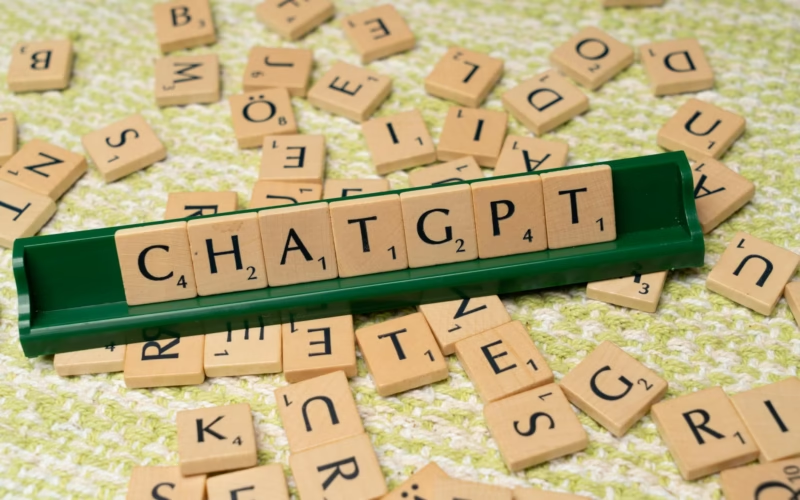
Transforming the Classroom: An Essential Guide to the Benefits of Artificial Intelligence in Learning
AI in Education is no longer a concept limited to futuristic speculation; it is a rapidly evolving reality fundamentally changing how students learn, how teachers teach, and how educational institutions operate. The integration of Artificial Intelligence (AI) into learning environments promises a revolution, moving educational models away from the rigid, standardized approaches of the past toward adaptive, highly personalized experiences designed for the 21st century. This comprehensive guide explores the powerful and best benefits AI brings to the educational landscape, detailing how this technology serves not as a replacement for human educators but as one of the most significant assistive tools developed in modern schooling.
The promise of AI in the classroom extends far beyond simply automating tasks. It involves creating sophisticated, data-driven systems capable of analyzing individual student behavior, identifying critical knowledge gaps instantaneously, and deploying targeted interventions that maximize efficacy. Understanding these benefits is crucial for educators, administrators, and policy makers preparing to embrace the future of learning.
The Core Benefit: Hyper-Personalization of Learning Pathways
For decades, educators have strived to personalize learning, recognizing that every student processes information at a different pace and through unique modalities. Traditional classroom structures have made true personalization nearly impossible due to constraints on teacher time and resources. AI dissolves these constraints, establishing customized learning environments tailored precisely to individual student needs and preferences.
Adaptive Learning Systems
One of the most potent applications of AI in education is the development of adaptive learning systems. These programs use machine learning algorithms to continuously analyze student performance data, including response times, error patterns, and engagement levels. Based on this real-time analysis, the system dynamically adjusts the curriculum, content difficulty, and instructional method.
If a student masters a concept quickly, the AI accelerates the path to more complex material. Conversely, if a student struggles, the AI isolates the precise prerequisite knowledge that is missing and offers targeted review modules, alternative explanations (such as video, text, or interactive simulations), or additional practice problems. This ensures that students are neither bored by overly simple material nor overwhelmed by content they are not yet ready for. The benefit here is maximizing learning efficiency and retention, as students spend their time exclusively on the material they need most.
Intelligent Tutoring Systems (ITS)
AI-driven intelligent tutoring systems go a step further than simple adaptive platforms. They aim to mimic the personalized, conversational feedback a highly skilled human tutor provides. Using natural language processing (NLP), ITS can answer open-ended questions, guide students through complex problem-solving processes, and offer detailed, instant feedback on written work or mathematical solutions.
These systems track metacognitive skills—how a student thinks about learning—in addition to raw performance. If a student consistently procrastinates or lacks confidence, the AI can offer proactive encouragement or scheduling tools. This level of personalized guidance helps foster not just content knowledge, but essential self-regulation and study skills required for lifelong learning.
Maximizing Teacher Potential Through AI in Education
A pervasive myth surrounding AI in education is that it aims to replace the educator. In reality, AI serves as an indispensable administrative and analytical assistant, liberating teachers from mundane, time-consuming tasks and allowing them to focus their energy on high-value interactions that require human empathy, creativity, and mentorship.
Automation of Grading and Assessment
Teachers spend an astonishing amount of time grading routine assignments, quizzes, and even standardized tests. AI tools can automate the grading of multiple-choice questions, fill-in-the-blank problems, and increasingly, complex essays. Sophisticated algorithms can assess not just factual correctness but also elements like syntax, organization, and adherence to assignment parameters.
Furthermore, AI-powered assessment tools provide instantaneous diagnostic feedback to the teacher, not just a score. Instead of waiting days to grade 100 papers, teachers receive immediate data showing common errors across the cohort, identifying which students are struggling with which specific learning objective. This immediate feedback loop is critical for timely classroom adjustments and intervention planning.
Data-Driven Decision Making
AI systems generate vast amounts of data—far more than any human teacher could realistically analyze manually. This data includes information on student flow through lessons, time spent on specific concepts, emotional indicators (where possible via advanced platforms), and predictive indicators of success or failure.
AI translates this raw data into actionable insights for the teacher. A teacher can quickly pull reports indicating:
Which instructional module provided the highest average student retention.
Which students are at highest risk of falling behind in the next grading period.
Whether a specific teaching method is more effective for visual learners versus auditory learners within the class.
By providing clear, predictive analytics, AI empowers teachers to make instructional choices based on evidence, significantly enhancing the effectiveness of classroom management and instruction.
Enhanced Accessibility and Equity
One of the most profound ethical benefits of AI integration is its potential to level the playing field, making high-quality education more accessible and equitable regardless of location, disability, or native language.
Specialized Support for Diverse Learners
AI tools are invaluable for supporting students with special educational needs (SEN) or those facing barriers due to learning disabilities.
Text-to-Speech and Speech-to-Text: AI conversion tools help students with dyslexia or difficulty writing articulate their ideas efficiently.
Cognitive Load Management: AI can adjust the presentation of complex information, chunking it into smaller, manageable pieces to reduce cognitive load, aiding students with attention or processing challenges.
Personalized Pace: For students who require frequent breaks or more time to process instructions, AI systems patiently wait, providing non-judgmental repetition and self-paced navigation through the curriculum.
Breaking Down Language Barriers
In increasingly diverse classrooms, language difference presents a significant obstacle. AI translation tools, both written and oral, enable real-time communication between teachers and students who do not share a common language. Furthermore, AI-powered language learning apps provide immersive, highly tailored practice for English Language Learners (ELLs), adapting drills and scenarios to the student’s proficiency level faster than traditional software. This rapid support integrates students into the core curriculum quicker and more successfully.
Global Access to Resources
For students in remote or underserved areas, AI systems provide access to expert-level instruction and resources that were previously unavailable. Virtual reality (VR) and augmented reality (AR) powered by AI can create immersive simulated labs, field trips, and historical reconstructions, offering high-quality, hands-on experiences regardless of the physical constraints of the school environment. This significantly reduces educational resource disparity between wealthy and under-resourced districts.
Future-Proofing Student Skills for the Modern Workplace
Beyond content mastery, modern education must prioritize skills crucial for success in the future economy, such as critical thinking, collaboration, and digital literacy. AI helps shift the focus away from rote memorization toward these higher-order skills.
Fostering Critical Thinking Over Memorization
When AI systems handle the personalized tutoring of foundational facts and procedures, instructional time in the classroom can be dedicated to complex, project-based learning. Teachers use freed-up time to facilitate discussions, guide collaborative research, and coach students through real-world problem-solving scenarios that require creativity and argumentation—tasks fundamentally reliant on human synthesis and ingenuity, not machine computation. AI takes on the ‘what’ so students and teachers can focus on the ‘why’ and ‘how.’
Development of Digital and AI/ML Literacy
The classroom itself becomes a laboratory for understanding technology. Students interacting daily with intelligent tutoring systems and personalized feeds are naturally introduced to concepts of data security, algorithmic bias, and the functioning of machine learning (ML). This hands-on exposure to high-level tech fosters essential digital literacy, preparing students to be informed citizens and creators in an AI-dominated world, rather than just passive consumers of technology.
Addressing Challenges and Ethical Considerations
While the benefits are transformative, a comprehensive view requires acknowledging the ethical and practical hurdles accompanying AI adoption in education. These challenges often serve as motivation for careful, deliberate implementation.
Data Privacy and Security
The hyper-personalization enabled by AI relies on the continuous collection and analysis of sensitive student data. Educational institutions must adopt robust protocols and infrastructure to ensure compliance with privacy regulations (like GDPR and FERPA), managing the risk of breaches and unauthorized sharing. Trust is paramount; stakeholders must be confident that student data is protected and used solely for educational improvement.
The Digital Divide and Equity in Access
If AI tools are primarily implemented in well-funded districts with high-speed internet and access to devices, the existing achievement gaps could widen for students in disadvantaged communities. Closing this “digital divide” requires strategic investment in infrastructure and hardware to ensure all students, regardless of socioeconomic status, have equal access to the opportunities AI provides.
Maintaining Human Oversight and Connection
AI systems are powerful, but they lack human empathy, intuition, and the complex understanding of classroom social dynamics. The benefit of AI is realized most fully when teachers remain in control, using AI as a consultant rather than a dictator of curriculum. Maintaining the critical human connection between student and mentor is essential for fostering emotional intelligence, social skills, and overall well-being—areas where AI can only assist, never lead.
In conclusion, the integration of Artificial Intelligence into education presents one of the most exciting epochs in pedagogical history. By automating administrative overhead, delivering hyper-personalized instruction, boosting accessibility, and shifting the classroom focus toward necessary 21st-century skills, AI promises to significantly enhance both teaching efficacy and student growth. As educators thoughtfully navigate the implementation and ethical oversight of these powerful tools, AI will cement its role as the definitive engine driving a more efficient, equitable, and engaging global education system.
