

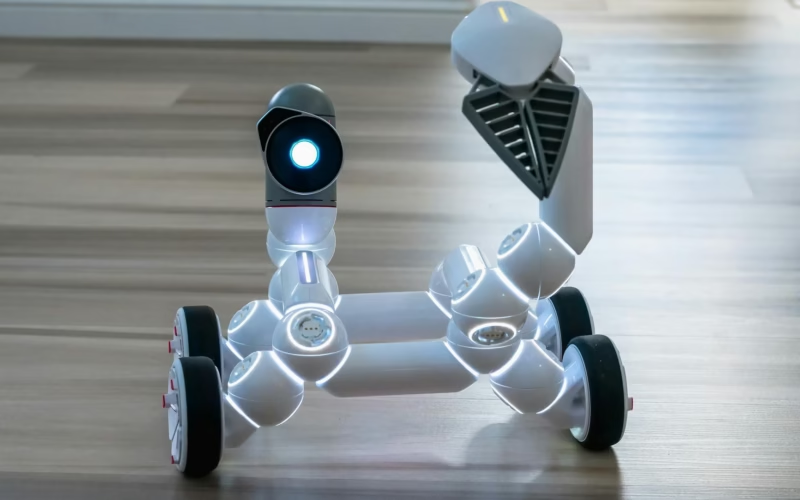
The Seamless Future: How Artificial Intelligence is Redefining Residential Living
AI Smart Homes represent perhaps the most significant evolutionary step in residential technology since the introduction of electricity. They are moving far beyond simple connectivity and basic automation, transforming our dwellings from passive structures into responsive, intuitive ecosystems designed around personalized human needs. The true power of artificial intelligence in the domestic sphere lies not just in executing commands, but in anticipating requirements, learning habits, and managing complex tasks silently in the background. This transition is making technology truly effortless, shifting the burden of management away from the homeowner and embedding a revolutionary level of intelligence into the very fabric of daily life.
To understand their revolutionary nature, we must first distinguish AI Smart Homes from their predecessors, standard automated homes. Automation relies on pre-programmed rules—if A happens, then B occurs. AI, conversely, relies on sophisticated algorithms to observe behavior, process immense amounts of data, and make probabilistic decisions. The result is a home that does not wait for an order, but rather understands the implicit routine of its occupants, optimizing comfort, energy use, and security with minimal manual interaction.
Beyond Automation: The Core Intelligence
The cornerstone of the AI-powered home is its ability to sense, learn, and predict. This intelligence is distributed across numerous devices, connected by a central hub or mesh network that processes inputs from cameras, microphones, thermostats, sensors, and even calendar data.
Sensing and Contextual Awareness: Modern AI homes employ sophisticated sensors that register not just temperature or motion, but context. For example, a standard thermostat might adjust based on the time of day. An AI-driven HVAC system, however, factors in exterior climate data, historical heating times, the number of occupants detected in various zones, air quality measurements, and even current utility pricing. It learns that on snowy Tuesdays, the occupants tend to gather in the living room earlier, and preheats that zone specifically while maintaining standby status elsewhere.
Machine Learning and Habit Formation: This is where the effortlessness truly emerges. Over time, the AI learns individual and group habits. It recognizes the difference between a normal late-night trip to the kitchen and an actual security anomaly. It understands that ‘movie night’ means dimming the main lights, activating accent lighting, lowering the blinds, increasing the TV volume slightly to compensate for the running dishwasher, and silencing external notifications—all without a single voice command or button press. The goal is friction reduction: removing the cognitive load associated with managing dozens of interconnected systems.
Predictive Maintenance and Efficiency: Perhaps the most practical application of home intelligence is predictive care. AI monitors the performance metrics of appliances and utilities. It can detect subtle changes in motor vibrations, energy draw spikes, or communication delays that indicate impending failure. Instead of relying on a human to notice a problem, the AI schedules a professional inspection or alerts the homeowner that a consumable component needs replacement before the system fails. This extends the lifespan of expensive equipment and prevents costly emergencies.
Revolutionizing Daily Comfort and Safety
The practical impacts of an intelligent residential environment span every facet of habitation, turning mundane tasks into seamless experiences.
Energy Management and True Sustainability
Saving money and reducing environmental impact are major incentives for adopting AI environments. AI optimizes energy consumption far more effectively than traditional programming. It dynamically loads devices based on grid stability and time-of-use rates, often shifting high-draw activities like running the dryer or charging an electric vehicle to off-peak hours without user intervention. Furthermore, sophisticated algorithms can precisely balance humidity, airflow, and temperature based on the architectural thermodynamics of the specific structure, ensuring maximum comfort is achieved with minimum BTU output. This layered optimization results in energy savings that far surpass the capabilities of simple programmable timers.
Proactive Security and Safety
Traditional home security is reactive; an alarm sounds after a breach. AI transforms security into a proactive, analytical process. AI-enabled surveillance systems do not just detect motion; they classify the motion. They can distinguish between a family pet, a delivery driver, a leaf blowing across the lawn, and a trespasser scaling a fence. Furthermore, behavior AI can spot an anomaly in the regular pattern—for instance, recognizing that the front door was held open for too long, or that a vehicle has been parked outside the property for an unusually long duration, triggering an immediate, context-based alert.
Moreover, AI integrates safety features beyond intrusion. It monitors smoke alarms, carbon monoxide sensors, and water leak detectors, and in the event of an emergency, it can follow a pre-programmed emergency protocol—notifying authorities, unlocking doors for first responders, and shutting off gas lines, all autonomously.
Hyper-Personalization of Environment
The intelligent home environment adapts moment-to-moment based on who is present. Through biometrics (facial recognition, unique voice patterns, wearable tracking), the home knows if the primary resident, a guest, or a child has walked into a room.
The house can instantly adjust lighting temperature (switching from stimulating blue-white light to relaxing warm amber), curate individualized music streams, and recall screen preferences. Imagine walking into your home after a long day; the AI already knows your mood based on the time and your historical data, greeting you with the appropriate light levels and background soundscape to aid in decompression. When the teenager comes home, the lights automatically shift to a brighter, study-friendly setting in their designated workspace.
Achieving Effortless Living with AI Smart Homes
The ultimate goal of adopting advanced intelligence into the home is the disappearance of the technology itself. The systems become so intuitive and integrated that they feel less like tools and more like an extension of the inhabitant’s own desires—true effortless living.
This seamless experience is achieved through several key mechanisms:
Semantic Interpretation: Voice assistants are evolving beyond simple command recognition. Modern AI platforms are capable of semantic interpretation, understanding intent rather than requiring specific phrasing. Saying, “It feels stuffy in here,” triggers a complex chain of actions: adjusting the ventilation, checking the air quality monitor, and perhaps opening a window slightly, depending on the outdoor temperature—actions far beyond the capability of basic “turn X on” commands.
Behavioral Triggers and Routines: The AI learns that when you put your keys on the charging pad at 7:00 PM, specific actions should follow: the exterior doors lock, the oven preheats to 350 degrees, and the news digest starts playing softly in the kitchen. These routines are not programmed by the user but suggested and learned by the AI based on observed repetition, drastically simplifying the daily closing sequence of the house.
Interoperability and Ecosystem Cohesion: The true “effortless” experience requires total communication between devices, regardless of manufacturer. AI serves as the translator and mediator between disparate protocols (Zigbee, Z-Wave, Wi-Fi, Matter), ensuring the security camera, the HVAC unit, and the dishwasher seamlessly communicate status updates and coordinate resource allocation. When the dishwasher finishes its cycle, the AI recognizes the noise level drop and adjusts the living room speaker volume accordingly—a subtle but significant reduction in daily friction.
Navigating the Future: Challenges and Ethical Considerations
While the promise of AI Smart Homes is exhilarating, their widespread adoption introduces critical challenges centered on infrastructure and ethics.
Data Security and Privacy
A home that knows everything about its occupants—their schedules, health metrics, spending habits, and movement patterns—is a massive repository of sensitive data. The security and privacy of this intensely personal data must be paramount. Homeowners need surety that data is encrypted, processed locally wherever possible (edge computing), and not mined by third parties for commercial gain without explicit consent. As homes become more connected, they also become higher-value targets for cyber threats. Robust, state-of-the-art encryption protocols are non-negotiable for ensuring the sanctity of the domestic environment.
The Problem of Interoperability
Despite efforts toward unified standards, proprietary ecosystems still create friction. A major ongoing challenge is ensuring that a cutting-edge sensor from one brand can reliably and easily communicate its data to a core AI system manufactured by a competitor. Future AI Smart Homes must fully commit to open standards (such as Matter) to allow consumers the freedom to choose best-in-class components without worrying about system compatibility.
Cost and Accessibility
Currently, setting up a truly intelligent, comprehensive AI ecosystem represents a significant investment. For the AI revolution to be truly successful and equitable, the cost of entry for smart components and the necessary supporting infrastructure must decrease, making the benefits of energy efficiency and enhanced security available to a broader range of socio-economic groups. Scaling production and integrating AI capabilities directly into standard construction materials will be key to achieving this affordability.
The Autonomous Dawn
The journey towards the truly intelligent residence is ongoing, but the trajectory is clear. AI Smart Homes are not merely conveniences; they are foundational shifts in how we interact with our environment. They promise a future where technology is neither visible nor cumbersome, a world where the house manages itself, optimizing resources and comfort so that occupants can focus on living.
As AI progresses, homes will transition from being highly responsive to truly autonomous, making complex decisions regarding maintenance, logistics (like managing grocery stock and package delivery protocols), and personalized well-being programs. Through the quiet dedication of advanced algorithms, the concept of effortless, revolutionary living is fast becoming the new standard for the modern residential experience.
